Understanding hypermobility, HSD & hEDS
Understanding how symptomatic hypermobility is described
You may have come across the terms Hypermobility Spectrum Disorder (HSD) or hypermobile Ehlers-Danlos Syndrome (hEDS).
These are diagnostic frameworks used to describe patterns of symptomatic hypermobility.
While they can be helpful for guiding care, they don’t always capture the full lived experience of being in a hypermobile body, which is often complex, multi-system, and doesn’t fit neatly into a single category.

How hypermobility relates to HSD & hEDS
Hypermobility describes how joints move.
When it occurs alongside symptoms, these patterns are often described using terms like HSD or hEDS.
Throughout this site, symptomatic hypermobility is used as a way of understanding these patterns, regardless of whether a formal diagnosis is present.
HSD & hEDS- Different Labels, Similar Experiences
You might have heard terms like:
• Hypermobility Spectrum Disorder (HSD)
• Hypermobile Ehlers-Danlos Syndrome (hEDS)
These are different ways of describing how symptomatic hypermobility shows up in the body.
While they are defined differently, there is often significant overlap in how they are experienced.
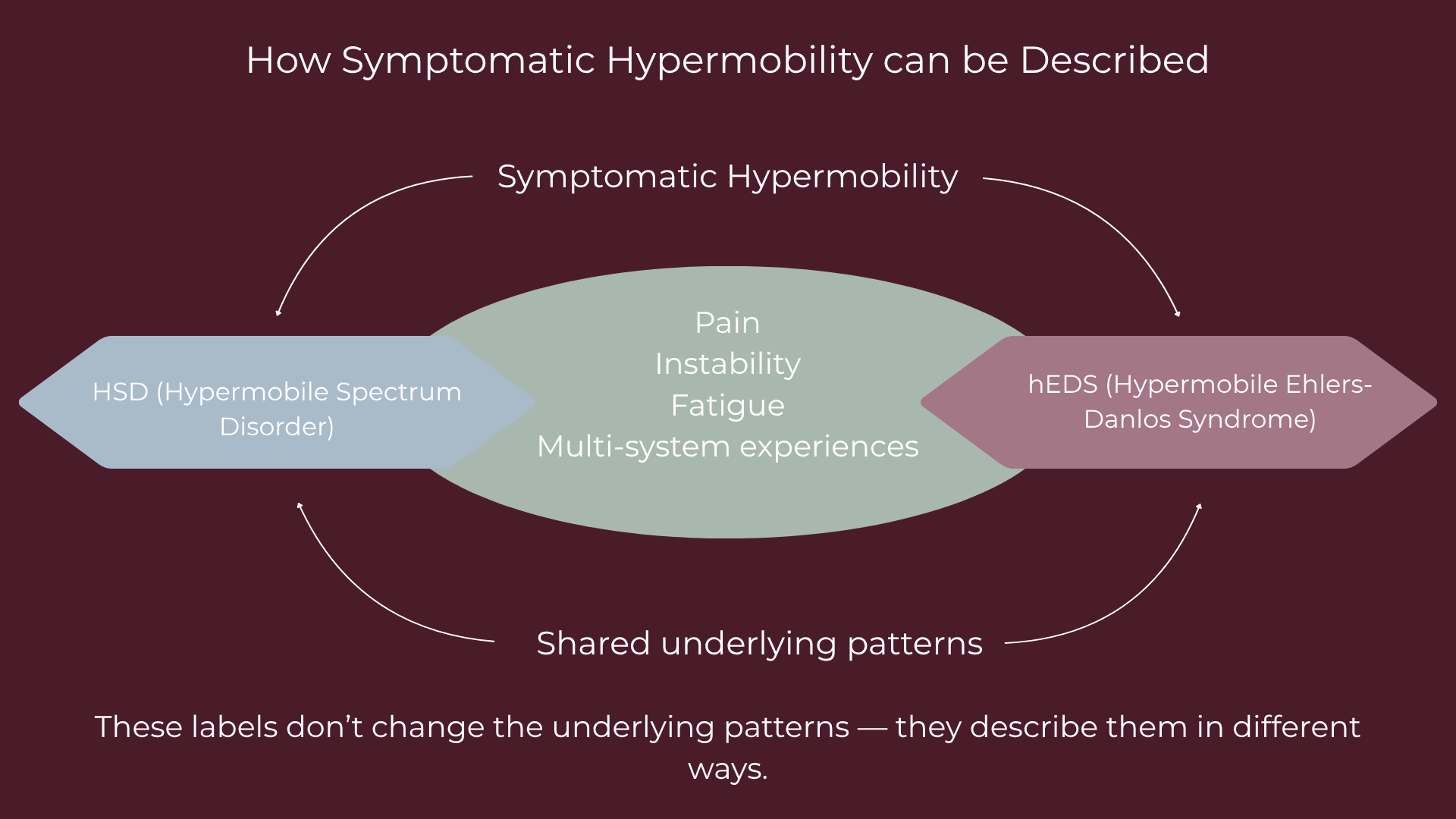
These distinctions can be helpful, but they don’t always capture the full picture.
HSD
May involve pain, instability, or multi-system symptoms
Does not meet the current diagnostic criteria for hEDS
hEDS
Meets specific diagnostic criteria based on current guidelines
May involve broader systemic features alongside hypermobility
Many people experience overlap between these patterns, regardless of diagnosis.
Why are these diagnoses used?
These diagnoses are used to recognise patterns, guide care, and help communicate what may be happening in the body.
For some people, receiving a diagnosis can bring clarity, validation, and support in navigating their health.
For others, the process can feel confusing — especially when their experiences don’t fit neatly into defined criteria.
These frameworks can be helpful, but they don’t always capture the full complexity of an individual’s experience.
So where does this leave you?
Do you need a diagnosis?
A diagnosis can be helpful for accessing care, understanding your body, guiding management and feeling validated.
But it isn’t required to begin exploring or supporting your health.
What if you don’t fit neatly into a category?
Many people don’t fit neatly into diagnostic definitions.
Some are in the process of seeking answers.
Others have received different explanations over time.You may recognise patterns in your body without having a formal diagnosis, and your experience is still valid.
Where might you fit?
Some people experience symptoms primarily related to joint hypermobility and musculoskeletal concerns.
Others notice broader patterns across multiple body systems alongside hypermobility.These experiences may be described using terms like HSD or hEDS, depending on how they present and how they meet current diagnostic criteria.
There is often overlap between these patterns.
These patterns exist on a spectrum, and many people experience features across multiple categories.
There isn’t always a single category that captures the full picture. What matters more is understanding how your body is responding, and what it needs.
If you’re still making sense of your symptoms, you can start here.